say they have learnt something new.
353 positive responses out of approximately 368 valid responses to this item.Back to home
Impact, history and publications
15,000+
Pupils since the project began
300+
Schools over the life of the project
2017
The beginning of a shared enquiry
1,200+
Survey responses across project editions
Reach over time: UB project review, June 2026. Surveys: cumulative figures supplied by the project coordinator; the individual analyses are presented separately.
04 / LISTENING IS PART OF EVALUATION
What pupils tell us.
What the project teaches us.
Findings from the initial analysis for 2025–2026, reported in the FECYT activity report.
rate the final event positively.
322 positive ratings out of approximately 380 valid responses.Science4.17/5
Technology4.03/5
The analysis also highlights an opportunity: to make the mathematics behind each project more visible.
A growing body of evaluation
More than 1,200 survey responses collected across editions, according to the project coordination team. Frontiers in Nanotechnology (2025) reports approximately 800 pupil responses from earlier editions; the 2025–2026 activity report presents an initial analysis of 476 records.
Building, explaining and asking questions
The report’s qualitative analysis highlights teamwork, model design, presenting ideas and meeting experts. Responses also help improve the layout, noise levels and timing of the fairs.
How to interpret these findings +
These are self-reported perceptions. The number of valid responses varies by question; the cumulative survey total is not the denominator for these percentages. Earlier datasets and the 2025–2026 data are analysed separately: they cannot establish a trend between percentages or isolate the effect of any particular technology. Subject averages are reproduced as given in the report; its summary does not specify the number of valid responses for each average.
Source: Memoria_actividades_realizadas_21428.pdf, pp. 36–40, and Frontiers (2025), section 3.4.1.6. The revised Word document supplied by the project coordination team gives the cumulative figures.
FROM CLASSROOM TO COMMUNITY
Science is also
learnt through
conversation.
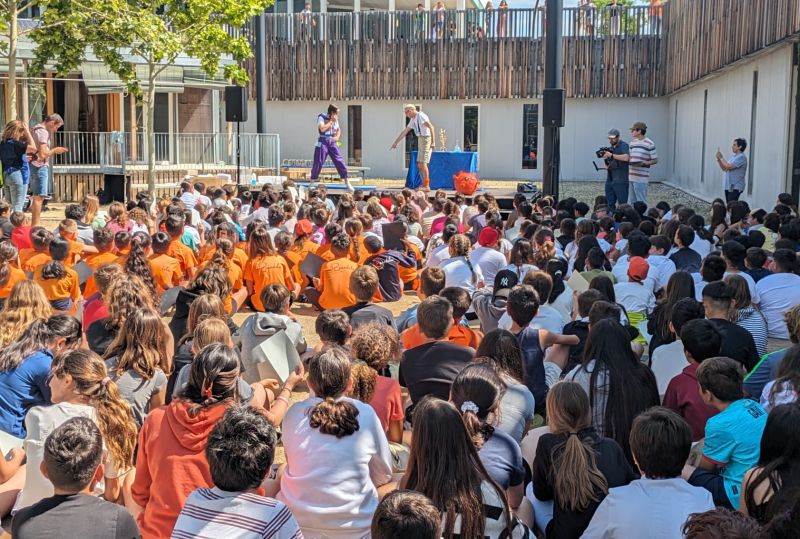
A researcher comes over to the table, listens to the proposal and asks a question. The team explains, hesitates and searches for an answer. The fair gives their work a real audience.
Through Nanoexpertas km0, pupils meet local role models. Meeting other schools and people who carry out research makes presenting their work part of the learning process.
Read IE Tramuntana’s account06 / EXPLORE FURTHER
The project is also
documented and studied.
01TRACK RECORD AND EVIDENCE
What makes NanoInventum different?
A look at the materials, schools, recognition and publications that document the programme.
Read the blog post02MIXED REALITYNanoverse XR and the invisible frontier
The mission, hands-on challenges and instructions for exploring a nanotechnology challenge trail.
Explore the experience03SCIENCE THROUGH STORIESHely and the food that gives us energy
Another way into the project: exploring science through its characters and comic series.
Read the comicResearch and educational publications
2025 · FRONTIERS IN NANOTECHNOLOGYShaping the future of nanotechnologyDíaz-Marcos and Mendoza Gonzálvez · educational perspectives and project evaluation2024 · ALAMBIQUE 115Nanociencia, creatividad y sostenibilidad en el aula de primariaDíaz Marcos, Díez Palomar and López Rebollal · pp. 60–682026 · DYKINSONVisualizando lo invisibleDíaz Marcos and Mendoza Gonzálvez · education and technological responsibility, pp. 125–14507 / Independent recognition
A track record recognised beyond the classroom.
Premios Gutenberg
Winner in the “Grandes éxitos” category, as reported by UPF Barcelona School of Management.
Read the sourceBaldiris Experiències
An award associated with Escola Tecnos, recorded in NanoInventum’s official project history.
Explore the project’s historyFalling Walls Engage
NanoInventum and Jordi Díaz appear on the official 2025 shortlist: an international selection recognising public engagement with science.
View the official shortlistSTEM Discovery Campaign
Recognition for “Nanoexpertas km 0” from Scientix / European Schoolnet, documented by UB.
Read the institutional reportCiencia en Acción
Honourable Mention for “Nanorobots Nanoinventum”, recorded in the jury’s proceedings, for introducing primary pupils to nanotechnology through creativity and school models.
Official proceedings · PDF page 283These distinctions reflect external recognition; they serve a different purpose from evaluating learning outcomes.
08 / CONTINUITY AND SHARING THE APPROACH
Since 2017.
With much more to share.
The first idea
Introducing primary pupils to nanotechnology as part of 10alamenos9.
Testing and refining
A pilot in five schools, collaboration with CESIRE and the development of NanoExplora.
More engineering
TECNanoInventum and the addition of LEGO and Micro:bit robotics to models in some schools.
Building a legacy
MOOCs, Nanoverse XR, a chatbot and a guide to help others carry the approach forward.
An approach that travels
NanoInventum has successfully expanded to Alicante, Castro Urdiales, Valencia, Zaragoza, Asturias, Salzburg, Costa Rica and Mexico.
Read the legacy report09 / TRACE THE EVIDENCE
Evidence you
can explore.
UB · Project history, reach and the end of a phase (2026)UB · Robotics and TECNanoInventum (2024)NanoInventum · Origins and early yearsConsorci d’Educació · Programme outline for 2026–2027IE Tramuntana · A school shares its experienceFalling Walls · Official selection (2025)
Internal documentation and how to read the evidence +
Sources consulted include the FECYT activity report Memoria_actividades_realizadas_21428.pdf and the revised award submission supplied by the project coordination team. Figures for the project’s history, individual editions, events and digital channels cover different aspects of the programme. Pupils’ creations are presented as conceptual models. The questions on the project cards are teaching prompts written for this website.
NANOINVENTUM · SCIENCE TO SHARE