A complete learning journey. From teacher training to the science fair.
We train teachers, open the experiment kit, build a model and present it at a science fair. Four connected stages of learning, creating and sharing science.
01
Train the teachers
Teachers receive nanoscience training and practical teaching guidance to bring the project into their classrooms.
A practical reference guide to preparing, organising and supporting a school science fair.
Nanoexpertas support this process. At the science fair, teams share their models, explain their reasoning and respond to new questions.
FROM CHALLENGE TO DESIGN
Build your own model nanorobot.
Turn what you have explored into an idea you can explain.
QuantumBot is the app pupils use to create the robots for their NanoInventum projects. Design is part of the enquiry: every component should answer a question, and every function needs an explanation.
From a mobile screen to an experiment. From an idea to a prototype.
Exploring the nanoscale, testing a function or sharing a discovery: each technology has a purpose within the learning experience.
Mixed reality · Experimentation · Collaboration
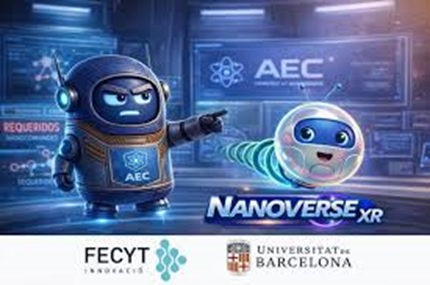
Nanoverse XR: the invisible frontier
An activity trail combines an interactive map, augmented-reality characters, clues and hands-on challenges. Teams move between digital exploration and experiments on scale, AFM, specific surface area, the lotus effect and functional materials.
The need
Give pupils observable reference points for concepts that cannot be seen with the naked eye.
Educational value
The mission connects the clues with observation and collaborative problem-solving.
Implementation
The implementation summary documents a trial with approximately 100 pupils in Alicante and a presentation to around 600 attendees in Barcelona. Presentation attendance and actual use are different measures.
Adaptation
Exploration and stationary modes are described in the resource guide.
Image: NanoInventum. Implementation figures: ‘El llegat de NanoInventum’ summary.
Gamification · Scientific challenges
A laboratory unlocked by solving puzzles
The website’s virtual escape room invites pupils to become detectives in a science laboratory. It offers a story-based introduction to the project through a puzzle-solving activity.
The need
Provide a participatory introduction to content that can seem abstract.
Classroom use
Use it in a guided session, followed by a discussion of the strategies pupils tried.
Evidence
The resource is published on the official website. No specific learning outcomes are claimed without an evaluation of the resource.
In 2024, the PUCRA and CIMA 3D student associations at EEBE–UPC helped some schools add robotics to their models using LEGO and Micro:bit.
The need
Explore the transition from a conceptual design to functions that can be tested in a school prototype.
Educational value
Connect the design, construction and control of a model, with support from engineering students.
Evidence
The University of Barcelona documents the introduction of robotics in some schools. The event brought together more than 900 pupils from 30 schools and displayed over 200 models; these figures refer to the event as a whole.
Scientific rigour
School-scale robotics models functions; it does not directly reproduce the physical behaviour of a nanorobot.
QuantumBot is the app NanoInventum pupils use to create the robots for their projects. Digital design forms part of the team’s work alongside drawing, building the model and explaining the proposal.
What will it need to do? Which parts does it need? How will we explain it? Design decisions shape each nano-invention and prompt new scientific questions.
Blogs and digital channels document each school’s journey and let teams share models, explanations and resources. Pupils’ work builds an educational archive that lives on beyond the fair.
The need
Make the process visible and preserve pupils’ work for reference and reuse.
Educational value
Structure an explanation, justify a proposal and communicate with different audiences.
External evidence
Schools publish their own accounts: Institut Escola Tramuntana documents its work and its participation in the 2025 fair.
The two Universitat de Barcelona MOOCs bring together scientific foundations, applications and educational approaches. They offer a way to study at your own pace and prepare new classroom experiences.
The need
Reduce reliance on in-person support and keep teacher learning opportunities available.
Evidence
The FECYT report lists 2,045 visitor records, 634 enrolments, 422 course starts and 95 completions across the two courses. Individuals may appear in both courses.